

Can you make a spring work wardrobe feel fresh without buying a new color palette? Yes. The strongest edit usually comes from removing duplicates, correcting proportions, and changing how existing pieces work together. Treat the closet like a small case file: identify what performs, separate what only looks useful, and keep evidence before spending money. This is not legal advice—consult a licensed attorney; the wardrobe guidance below is general style information.
Which existing pieces should stay, rotate, or leave?

Use a three-way decision instead of keeping every garment in active circulation. “Stay” means the item earns regular wear. “Rotate” means it works for a narrow season or setting. “Leave” means it is damaged, uncomfortable, redundant, or incompatible with the rest of the wardrobe. The table below gives a practical baseline for a neutral spring work wardrobe.
The working baseline
| Wardrobe role | Useful quantity | Keep when | Typical action |
|---|---|---|---|
| Tailored trousers | 2 to 3 pairs | They fit at the waist and create at least three outfits | Keep the best two; tailor or rotate the third |
| Work blouses or shirts | 4 to 6 pieces | The neckline works under your jackets and the fabric is easy to care for | Keep varied shapes, not six near-identical white shirts |
| Blazers or structured layers | 1 to 2 pieces | The shoulder line is clean and the jacket closes comfortably | Keep one reliable layer; rotate the second by temperature |
| Skirts or dresses | 2 to 4 pieces | You can sit, walk, and layer without constant adjustment | Keep the most practical silhouettes |
| Work shoes | 2 to 3 pairs | You can walk and stand in them for a full day | Retire pairs that cause pain, even if they look polished |
The duplicate test
Place similar items together. If three black trousers all serve the same purpose, keep the pair with the best fit and fabric, then test the third against your actual schedule. Your existing pair wins if it fits better and survives your care routine.
For a spring work wardrobe, the verdict is simple: keep the garment that creates more complete outfits with fewer adjustments.
How do you edit by outfit function instead of color?
The most useful way to refresh a fixed palette is to change the relationship between pieces. Imagine a wardrobe built from navy, black, cream, gray, and denim. That palette does not need another color to look different. It needs contrast in shape, finish, and proportion. A fluid blouse under a sharp blazer creates a different message from a crisp shirt under the same jacket. A straight trouser with a low-profile loafer reads differently from a wide trouser with a pointed flat. The colors stay still; the outfit changes.
Build three formulas from the same core pieces
Start with one trouser, one top, and one layer. Formula one might be a navy straight-leg trouser, cream blouse, and black blazer. Formula two keeps the trouser but swaps in a fine-gauge knit and a cropped jacket. Formula three removes the jacket, adds a long cardigan or polished overshirt, and changes the shoe. Photograph all three. If each outfit looks distinct in a small phone image, the edit is doing real work.
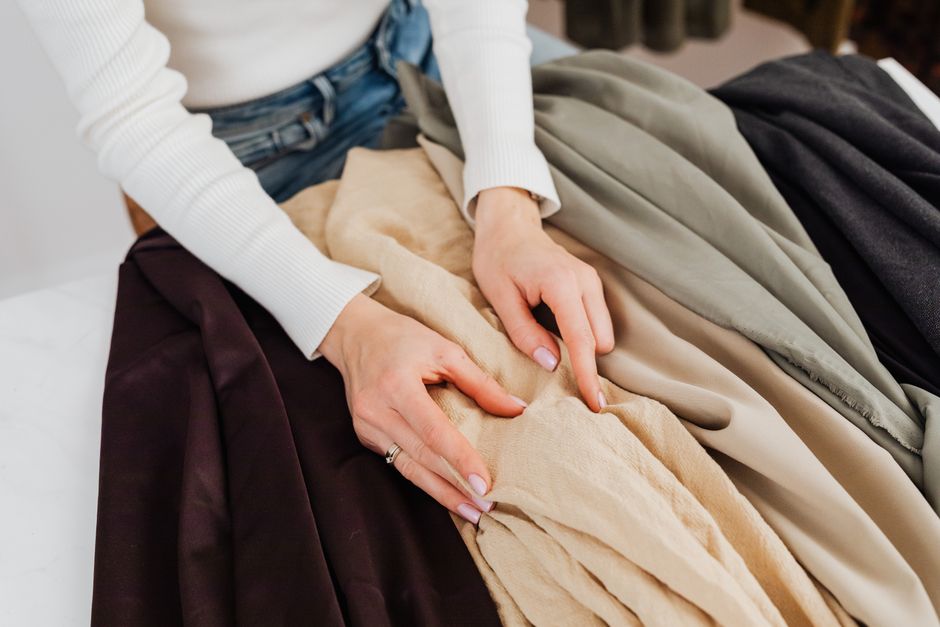
Neither needs to enter your closet. Their different drape and sheen show how fabric can create variety inside one palette.
Change texture before adding color
Spring outfits often improve when one surface becomes lighter or more tactile. Try cotton poplin with wool trousers, a matte knit with satin, or a smooth blazer over a ribbed shell. Keep the base colors controlled so the texture carries the visual interest. This also solves a common failure mode: buying a new shade because the current outfits feel flat when the real issue is that every item has the same finish.
Use accessories with restraint. A leather belt, metal watch, silk scarf, or woven tote can mark a new outfit without creating a new palette. For most work settings, one changed proportion and one changed texture produce a cleaner result than several new colors competing at once.
What is the five-pass wardrobe edit?

Do not empty the entire closet at once. Work in passes so each decision has a clear test. The following sequence usually takes one afternoon and produces a usable spring rotation.
Passes one through three
- Pass one: remove the obvious exits. Set aside items with stains, broken closures, stretched waistbands, damaged heels, or fabric that makes you overheat. Do not keep a garment in active rotation because it might become useful someday.
- Pass two: check the calendar. Count how many meetings, office days, travel days, and formal events you have in a normal month. Keep enough coverage for those events, then stop adding imagined scenarios.
- Pass three: test the fit. Sit at a desk, raise your arms, walk up stairs, and wear the garment for ten minutes. A jacket that looks good while standing may pull across the back when you reach for a bag.
Passes four and five
- Pass four: make complete outfits. Every active garment should form at least three outfits with the rest of the wardrobe. Photograph the combinations and mark the ones that need constant tucking, pinning, or special underwear.
- Pass five: assign a decision. Label each piece stay, rotate, repair, tailor, donate, or replace. Do not use “maybe” as a storage category. If a garment needs repair, set a deadline and a cost limit; if it misses both, remove it from the active wardrobe.
This method catches another common mistake: confusing ownership with availability. A closet can contain plenty of clothes and still lack a complete Monday outfit. The five-pass edit measures usable combinations instead.
Can a fixed palette still look fresh?
Yes, but the refresh must come from movement, not random additions. These questions address the points that usually stall an edit.
What if every outfit looks too serious?
Loosen one element, not the whole outfit. Try a relaxed trouser with a tucked shirt, a clean sneaker on a casual office day, or a soft knit under a structured jacket. The contrast keeps the outfit professional while removing stiffness. Avoid adding several casual elements together unless your workplace clearly supports that level of informality.
What if the wardrobe feels repetitive?
Change the order of operations. Wear the jacket open one day, belted another, and over a different neckline on a third day. Switch the shoe shape before changing the color. A pointed flat, low-profile loafer, and sleek sneaker can give one trouser three distinct lines. If the same item still creates no good outfit after three tests, remove it rather than forcing variety.
What if spring weather changes during the day?
Build a removable layer into each formula. A fine cardigan, unlined blazer, cotton overshirt, or lightweight trench can handle a cool commute without making the indoor outfit heavy. The practical rule is to carry one layer that works with at least three outfits. A layer that matches only one dress is a weak purchase, even if it looks excellent on its own.
Freshness comes from controlled variation: one shape, one texture, or one styling move at a time.
When should you buy one replacement—and when should you not?
A no-new-palette challenge does not mean you can never buy anything. It means a purchase must solve a documented gap. Buy one replacement when an essential garment fails a comfort, fit, or coverage test and no existing item can take its place. Do not buy when the desire comes from boredom, a social-media image, or a color that has no outfit partners.
Buy when the gap is measurable
A replacement earns its place when you can state the problem in one sentence: “I need a washable layer for three client-meeting outfits,” or “I need trousers that fit after sitting for eight hours.” The item should have a defined color relationship, care requirement, and budget. For example, a washable Uniqlo Rayon Blouse may solve a need for a light layer, while an extra statement blouse may not. Compare the garment with at least three existing bottoms before buying it.
Do not buy when the edit has not finished
Wait if you still have untested clothes in storage, pending repairs, or duplicate basics. Also wait if the proposed item requires new shoes, a new bag, and new jewelry to look complete. That is not one purchase; it is a new system. The better alternative is to use the current palette and change fit, texture, or styling first.
The most defensible spring wardrobe decision is usually the smallest one: remove what fails, repair what earns its place, and buy only when a specific outfit gap remains. A focused edit makes an existing palette feel new because it gives every useful garment a clearer job.
