
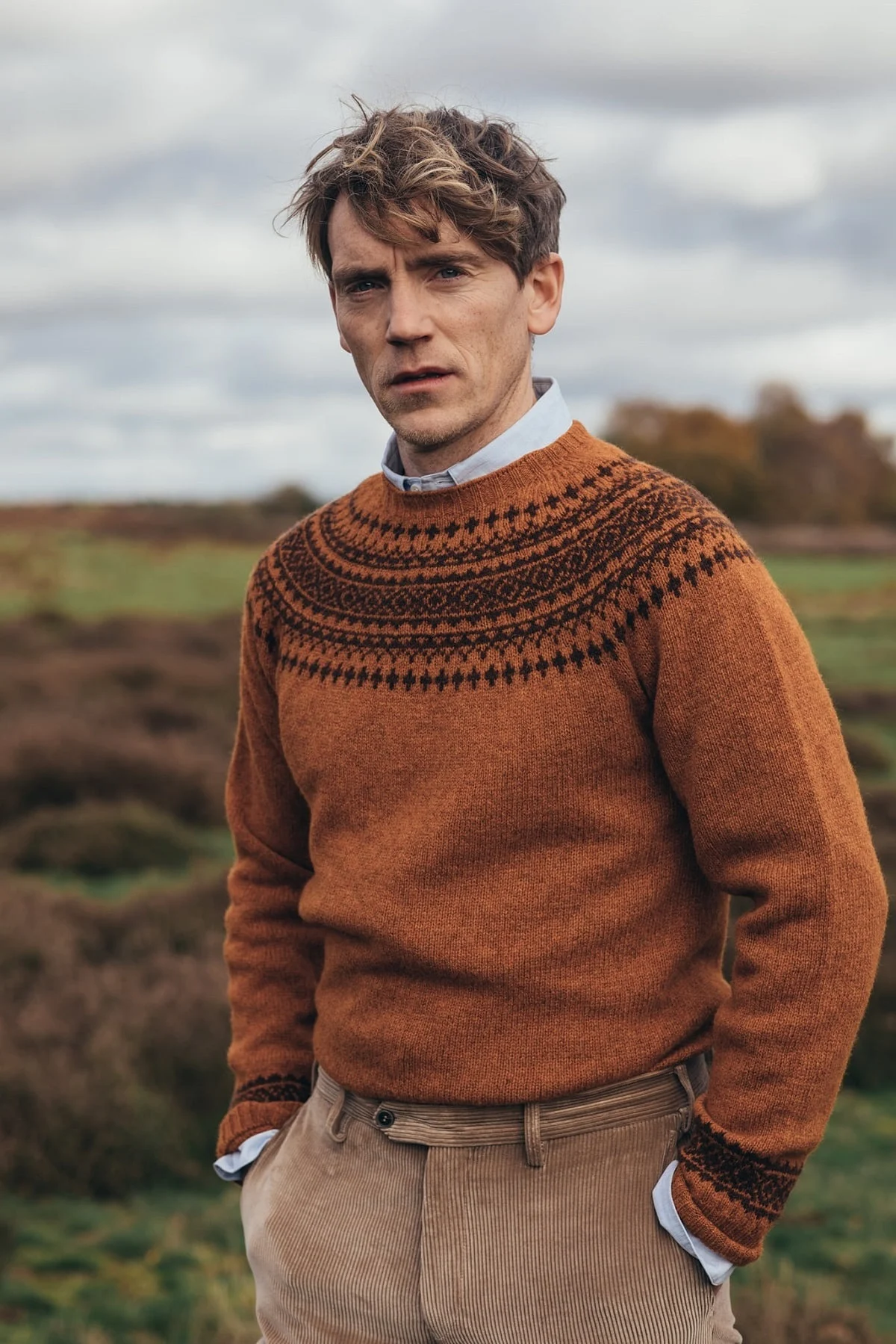
Have you ever held a Fair Isle sweater and wondered why it feels different from everything else in your wardrobe? Heavier than it looks. Warmer than the thickness suggests. With a surface texture you cannot quite name.
That is Shetland knitting — and the answer goes deeper than pattern or color. Shetland knitting is a textile tradition from the Shetland Islands, an archipelago sitting 170 miles off Scotland’s northeast coast. It is not a single technique. It is two distinct disciplines — stranded colorwork (what most people call Fair Isle) and Shetland lace — that share an origin but produce completely different results. Understanding which is which, and what separates authentic Shetland work from mass-market imitations, is the foundation for any serious buyer or learner.
The Geography That Built a Craft Tradition
Shetland sits at 60°N latitude — the same as Oslo and Anchorage. The islands are treeless, exposed to North Atlantic weather year-round, and were historically isolated enough to develop knitting traditions with unusual technical precision baked in from the start.
The sheep are the starting point. Shetland sheep developed over centuries on the islands, producing wool with a fiber diameter typically between 20–24 microns. That is comparable to mid-grade merino, but with a different crimp structure and better memory — meaning it springs back after being compressed or stretched. It also felts more readily than merino, which matters when you understand how Shetland fabric behaves after wet blocking.
By the 18th century, knitted goods were Shetland’s primary export. Women knitted constantly — while walking, while cooking, during any moment that did not require both hands free. Quality was not a creative preference; it was economic necessity. The British crown taxed Shetland textile exports, and buyers elsewhere in the UK and Europe had standards. Patterns and techniques that produced durable, precise fabric were preserved. Patterns that did not were discarded.
This historical pressure is why Shetland knitting patterns carry highly specific gauge requirements. When a pattern specifies 30 stitches per 4 inches on 2.25mm needles, that is not a suggestion. The entire structure — float length, fabric weight, finished dimensions — depends on hitting that number.
What Fair Isle Actually Means
Fair Isle is a specific island within the Shetland archipelago: 3 miles long, current population under 70. The knitting style named after it uses two colors per row in repeating geometric bands. No row uses more than two colors. Floats — strands of non-working yarn carried across the back — are never longer than 7 stitches.
These are not stylistic rules. They are structural ones. Floats longer than 7 stitches pull the fabric and reduce elasticity. More than two colors per row creates uneven weight distribution and complicates tension management. The traditional constraints produce fabric that is warm, elastic, and consistent across the whole garment. Mass-market knitwear labeled Fair Isle often uses four or more colors per row, is machine-knit, and applies pattern as a print rather than weaving it into the structure. The label is used commercially as a synonym for colorful geometric knitwear. The authentic technique is considerably narrower than that.
Shetland Lace: A Completely Different Discipline
Shetland lace uses single-ply or fine 2-ply wool knitted at 36–44+ stitches per 4 inches, creating cobweb-weight open fabric. The famous ring shawl — a full-size shawl threaded through a finger ring — is the benchmark for fine Shetland lace work and reflects a genuine structural achievement: fabric that is both strong and near-transparent.
The standard reference for serious practitioners is A Legacy of Shetland Lace by Sharon Miller, documenting over 200 traditional patterns with full charts and historical notes. Lace only reveals its full geometry after wet blocking, where pinning the fabric to specific dimensions opens the eyelets and sets the drape. An unblocked Shetland lace shawl looks like a crumpled heap. Blocked correctly, it holds crisp open geometry indefinitely.
Fair Isle vs. Shetland Lace: The Data You Need to Choose
Both traditions require significant time investment. The question is which skill set you are building, and which fabric properties you want in the finished piece.
| Factor | Fair Isle Colorwork | Shetland Lace |
|---|---|---|
| Yarn weight | 2-ply jumper weight (~550m/100g) | 1-ply cobweb or 2-ply lace (~800–1200m/100g) |
| Needle size | 2.25–2.75mm | 1.5–2.25mm |
| Gauge (sts per 4in) | 28–32 | 36–44+ |
| Skill entry point | Intermediate | Intermediate to Advanced |
| Core challenge | Two-yarn tension, float management | Chart reading, stitch counting, lifelines |
| Shawl time estimate | 40–80 hours | 60–120 hours |
| Shawl yarn cost | $40–$120 | $25–$80 |
| Pattern visibility while working | Row by row | Only after blocking |
| Recommended first project | Stranded hat or mittens | Small sampler with lifelines every 10 rows |
For most beginners, Fair Isle colorwork offers faster feedback. You see the pattern build in real time. Lace demands trust in a process where 60+ hours of work does not show its shape until the final blocking session. Neither is objectively harder. They require different kinds of patience.
Why the Yarn Choice Is Non-Negotiable
Using the wrong yarn is the single most consequential mistake in Shetland knitting — and it is more technical than it sounds. Shetland patterns are calibrated to Shetland wool’s specific fiber diameter, crimp structure, and felting behavior. Substitute a superwash merino and you get different drape, different blocking results, and fabric that behaves inconsistently compared to the pattern’s intent.
Three yarns worth knowing before buying anything:
- Jamieson’s of Shetland Spindrift — the benchmark for Fair Isle colorwork. 2-ply jumper weight, 105m per 25g ball, available in over 180 colorways including all traditional Shetland palette shades. Approximately $4–$6 per ball depending on supplier location. Most published Fair Isle patterns are written specifically for Spindrift weight. There is no functionally identical substitute at this price point.
- Jamieson and Smith 2-ply Jumper Weight — produced by Shetland’s oldest surviving wool supplier, operating since 1954. Slightly softer twist than Spindrift, preferred by some knitters for next-to-skin garments. Same approximate yardage per ball. Less straightforward to source internationally; expect to order direct from the Shetland Wool Brokers website with 2–3 week shipping to North America.
- Harrisville Designs Shetland Style — a U.S.-produced Rambouillet and Corriedale blend. Not authentic Shetland fiber, but it knits at a comparable gauge. Around $8–$10 per 100g skein (approximately 217m). Good for swatching before committing to imported yarn. Widely available at U.S. retailers. Note that shipping from UK suppliers adds $15–$30 to international orders, which significantly changes the per-project cost calculation depending on your location.
Avoid superwash-treated wools for traditional patterns. Superwash processing removes the fiber’s scale structure, changing its response to wet blocking. A lace shawl knitted in superwash merino will not pin-block to the same crisp open geometry as untreated Shetland wool — the eyelets collapse and the drape runs heavier and less precise than the pattern intends.
Working Your First Fair Isle Chart: Five Concrete Steps
- Knit your swatch in the round, not flat. Fair Isle garments are almost always worked in the round. Most knitters purl looser than they knit, so flat-knitted gauge differs from circular gauge. Cast on 72 stitches on 2.25mm circular needles using Jamieson’s Spindrift, join in the round, and work a 4-inch swatch before trusting any gauge measurement.
- Start with a peerie pattern. Peerie means small in Shetland dialect — these are short repeating motifs, typically 5–7 stitches wide and 5–7 rows tall. The OXO peerie is the standard entry point: two colors, short repeat, clear visual rhythm. Search Ravelry for peerie patterns and filter by project count to find options with documented success rates. Tin Can Knits also publishes well-tested stranded colorwork patterns at multiple skill levels with clear gauge specifications.
- Manage float length deliberately. After the last stitch before a float, spread the stitches on your right needle to their natural width before pulling the working yarn to begin the next stitch. This sets float length without drawing the fabric in. Floats under 5 stitches need no catching. Floats of 5–7 stitches should be caught at the midpoint by bringing the non-working yarn under the working yarn once.
- Block aggressively and wet. Soak the finished piece for 20 minutes in cool water. Squeeze — do not wring — to remove excess water. Lay flat on a blocking mat and pin to the pattern’s specified dimensions. Shetland wool blooms significantly after wet blocking: stitches even out, tension inconsistencies disappear, and the finished fabric looks substantially more defined than before.
- Do not cut your work open on a first project. The steek — cutting a knitted tube to create cardigan fronts or armholes — is legitimate Shetland technique, but it is irreversible and terrifying for beginners. Work through at least one complete in-the-round project before attempting a steeked garment. Stranded mittens or a hat are the right starting point.
Four Questions That Trip Up New Shetland Knitters
Is every stranded colorwork sweater technically Fair Isle?
No — though the term gets misapplied constantly. Fair Isle refers specifically to a style originating on Fair Isle island, using no more than two colors per row in horizontal geometric bands. Norwegian colorwork (such as the Selbu tradition) uses a different motif vocabulary. Icelandic lopi sweaters use a single stranded colorwork yoke in heavier yarn with different construction. All of these are stranded colorwork, but they are not Fair Isle. The distinction matters when selecting patterns, because motif conventions and float management differ between traditions.
Can I substitute regular wool for Shetland wool?
Yes, with adjusted expectations. Harrisville Designs Shetland Style at $8–$10 per 100g is a workable substitute for learning the technique. For a finished garment you intend to wear for years, Jamieson’s Spindrift at $4–$6 per 25g ball is worth the cost and the shipping lead time. A pattern designed for Spindrift will behave noticeably differently in an untested substitute yarn — especially during blocking, where the structural differences in fiber show up most clearly.
Do I need to learn steeking?
Not for most first projects. Hats, mittens, wrist warmers, and yoke sweaters all work in the round without cutting. Steeking is required for traditional Shetland cardigans and some complex shawl constructions. If your first project is a pair of stranded mittens, you can defer steeking entirely until you have solid float management and consistent color tension.
How long will a first Fair Isle project actually take?
Budget double your normal time for plain stockinette at the same gauge. A stranded yoke sweater that would take 40 hours in single-color stockinette will likely run 80–100 hours with colorwork for someone learning float management simultaneously. A pair of stranded mittens — the right first project — runs 15–25 hours. Pattern designers consistently undercount actual knitting time for colorwork. Track your hours on the first project to calibrate future estimates accurately.
The Honest Trade-Off
A well-constructed Fair Isle yoke sweater in Jamieson’s Spindrift, blocked correctly and hand-washed, will outlast most machine-made knitwear by decades. The wool structure tightens slightly with each wash. The colorwork is architectural — part of the fabric structure, not a print — so it cannot fade or peel. The trade is 80–100 hours of your time and $60–$120 in materials against a garment that outperforms anything at a comparable retail price point, with a service life measured in decades rather than seasons.
The reader who picked up a Fair Isle sweater and noticed it felt different from everything else? That difference is real and entirely explainable. Now you know exactly what creates it.
